Expert roofing services including repairs, replacements, and maintenance work. Quality craftsmanship guaranteed.
Professional roof work covers everything from localised tile or slate repairs through to full roof stripping, new felt and battens, and complete re-covering. Getting the specification right — and using a builder who understands both the structural and weatherproofing aspects — is what separates a roof that lasts decades from one that leaks again within a year.
What the Work Involved
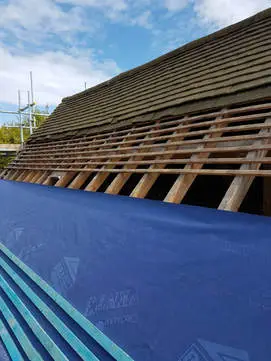
This project involved professional pitched-roof repairs and maintenance works carried out by P&R Mueller. Roofing is one of the most consequential areas of any building — a well-maintained roof protects everything beneath it, while a neglected one allows water ingress that can cause progressive damage to the structure, insulation, and interior finishes, often in places that are not immediately visible.
Roof work requires a builder who is confident working at height, understands pitched-roof materials, and can diagnose the root cause of a problem rather than simply patching the visible symptom. Common faults — slipped slates, failed lead flashings, blocked or damaged gutters, perished felt — have straightforward solutions when addressed promptly but become expensive when left.
Pitched Roof Repairs and Maintenance
Pitched roofs on older properties are typically covered in clay or concrete tiles or natural slate. The most common maintenance issues are:
- Slipped or cracked tiles and slates — often caused by nail fatigue or impact damage
- Failed or poorly fitted flashings at abutments, chimneys, and valleys
- Blocked or damaged gutters allowing water to back up under the roof covering
- Ridge tiles that have loosened as the mortar bed has deteriorated over time
- Roof felt that has perished, allowing any water that gets past the tiles to enter the building
Each of these faults can be addressed in isolation if the rest of the roof is in reasonable condition. Where the roof covering is broadly at end of life — typically after 40 to 60 years for concrete tiles or 80 to 100 years for good-quality natural slate — a full strip and re-cover is more economical than ongoing patchwork repairs.
Why Use a Master Builder for Roof Work?
Roof repairs carried out by unqualified contractors are one of the most common sources of building disputes. The combination of working at height, understanding waterproofing principles, and knowing how roofing materials behave over time requires genuine knowledge and experience. P&R Mueller's approach is to diagnose correctly first, specify the right repair or replacement, and carry out the work to a standard that will not need revisiting.
 1 / 6
Frequently Asked Questions
How do I know if my roof needs repairing or replacing?
A roof inspection — carried out from a ladder or from inside the loft — will usually reveal whether the problems are isolated or widespread. If fewer than 10-15% of tiles or slates are affected and the underlying felt and battens are sound, targeted repairs are normally the right approach. If the felt has perished, battens are rotten, or tiles are failing broadly across the roof surface, a full strip and re-cover is more economical over the long term.
What causes roof tiles to slip?
The most common cause of slipping tiles on older roofs is nail fatigue — the galvanised nails used to fix slates and tiles corrode over time, eventually losing their grip. This is particularly common on roofs that are 40 or more years old. High winds can dislodge tiles that have lost their fixing, and if the underlying felt has also perished, these gaps allow water directly into the roof structure.
What are lead flashings and why do they fail?
Lead flashings are the strips of lead used to seal the junction between the roof covering and vertical surfaces — chimneys, parapet walls, dormer sides, and roof abutments. Lead is used because it is malleable, durable, and can be shaped to fit complex junctions. Flashings fail when lead clips are missing (causing the flashing to lift in the wind), when the lead has been overworked and cracked, or when a poor-quality repair with mortar or sealant has been used instead of properly dressed lead.
How often should gutters be cleared?
Gutters should be cleared at least once a year — typically in late autumn after leaf fall. In areas with overhanging trees, twice-yearly clearing (spring and autumn) is advisable. Blocked gutters cause water to back up and overflow, which can saturate wall heads, cause damp in the property, and accelerate the deterioration of fascia boards and soffits. The cost of clearing gutters is trivial compared with the damage that blocked gutters can cause over time.
Can P&R Mueller carry out roof repairs in Worcestershire and Gloucestershire?
Yes — P&R Mueller carries out pitched-roof repairs, maintenance, and re-covering across Worcestershire, Warwickshire, and Gloucestershire. We have experience with the pitched-roof types common in this region, including clay plain tile, concrete interlocking tile, and natural Welsh slate.
Do I need scaffolding for roof repairs?
For anything other than minor work on a single, accessible section of roof, scaffolding is strongly recommended for safety and quality of work. Working from a ladder limits the builder's reach and stability, increasing both the safety risk and the likelihood of a poor-quality repair. Scaffold erection adds to cost but allows the work to be done properly and safely, and is legally required for many categories of roofing work under the Work at Height Regulations.
Thinking about a similar project?
We'd love to hear about your build. Get in touch for a free, no-obligation conversation.
Get in Touch